NEAR THE END of my two-day stay in Tintagel (with some reluctance to leave), it’s been time well spent in one of my favourite places on the planet: there are several such places on my itinerary during this trip, which is surely part of the point. But the work I had to do here is done; I have explored this wild, rocky part of the beauteous Cornish coast — framed by undulating fields that are still green in parts despite drought across Britain — and made my own judgements on two of the things that make Cornwall world famous: its pasties and its ice cream.
As most of us in Australia are only too well aware, drought = brown and dry, and brown and dry = fire risk: especially if some idiot flicks a cigarette butt into a clump of dry undergrowth and walks away…today the consequences of this were all too obvious, as the spectacular Cornish seascape had something unwanted added to it this morning, which smouldered away for hours despite the best efforts of local firefighters.

Had it happened somewhere dry fuel loads were concentrated in far greater quantities, there’s no telling how bad the carnage might have been. Fortunately, this was at the lower end of the scale of possible adverse outcomes — and so, we move on.
I can’t sing in praise of Tintagel loudly enough; aside from the palaver of actually getting to it, as I mentioned yesterday (which, counterintuitively, is perfect for the purpose I sought to research it), it’s gorgeous, populated by friendly people, is comfortable to stay in and explore, and — unlike some places in Britain — has some pretty good food experiences on offer, although they’re not Chelsea restaurant quality, just to be clear.
As I noted yesterday I’ve been staying at the Camelot Castle Hotel, which is part-owned by renowned British artist Ted Stourton, whose paintings (and there are many) adorn the corridors, common areas, formal zones and all of the accommodation rooms at the hotel, which itself is a castle (albeit not the famed Tintagel Castle, whose ruins are picked over by Arthurian history buffs from across the world: more on that later).

I’ve had the benefit of a couple of really good conversations with Ted while I’ve been here, and I’d like to stay in contact with him; despite his own success — and a reputation that rightly continues to grow — he is very available to his guests, knowledgeable about local history, and particularly keen to offer guidance and mentorship to artists in all disciplines and genres, not just painters. In this regard we had a great chat about the book projects I am working on, and I appreciated his counsel greatly. Whether aspiring creatively or simply looking for an excellent place to stay, however, Camelot Castle Hotel is deserving of patronage — not least on account of its thoroughly decent ownership and the culture of excellence that has flowed from that to the staff. Well done, and thank you!

Over the past couple of days I must have walked almost twenty miles; from Camelot to the Tintagel high street is (at my brisk pace) a 20-minute return walk, and I’ve done it six times today alone. One of the great things is that everything in this delightful little village is nearby, and I don’t think walking everywhere is going to kill anyone should they choose to do so: in my own case, maybe I’ll walk off a few of the 15-20 extra pounds that appeared after I quit smoking cigarettes if this type of thing continues for the duration of my trip.
But without giving too much away (all will be revealed in due course, provided the books I’m writing are published once eventually complete) it’s been a very satisfactory visit to Tintagel for research purposes; it’s no secret this has been chosen as one of the locations for what I’m working on, but how it fits (and exactly where, in terms of a trilogy of novels) can remain a mystery to others in my view, for now at least.

Nobody will ever know conclusively whether King Arthur was a real person, or simply a local legend; either way, the ancient lore of Camelot and the knights of the round table have charmed, haunted, entertained and inspired for literally hundreds of years. In some respects it doesn’t really matter whether the story is true or not: but the ruins of Tintagel Castle — reputed to be King Arthur’s seat — attract enthusiasts from across the world, and while the castle is of little interest to me in terms of my writing activities, the coast is another story: see Merlin’s Cave in the image above.
What I did discover this afternoon — almost to my chagrin — is that stories of Cornwall’s lightning-fast tides are no myth at all; I got talking to a lovely English girl between taking pictures and making notes, and within the space of 20 minutes (and being somewhat distracted) the incoming tide had advanced close to thirty feet. Interestingly, fresh tide marks inside Merlin’s Cave are visible about ten feet off the sand level: have another look at the image I’ve posted, and imagine the cave at least half full of water. As children, we read stories about the Famous Five playing on the water at “Kirrin” (which is somewhere in Cornwall — that’s a fact — but exactly where, I don’t know). Today, I got to see the surging, swirling, rising tide Enid Blyton’s characters had such fun playing chicken with for myself.
And to be sure, I wouldn’t want to get trapped on that beach after another 20 minutes or so on the incoming tide; the water isn’t as calm as it looks, and the rocks look…sharp, to say the least…
While I’ve been here, I’ve made it my business to sample (the bounds of moderation permitting) the local offer in two of the things Cornwall is famous for across the world: its pasties and its ice cream. In the case of the latter, a blackcurrant and Cornish clotted cream ice cream sealed a runaway win in my view for one of a plethora of local dairy firms with shopfronts in the high street: Kelly’s of Cornwall. If you come to this part of England, indulgence is mandatory.
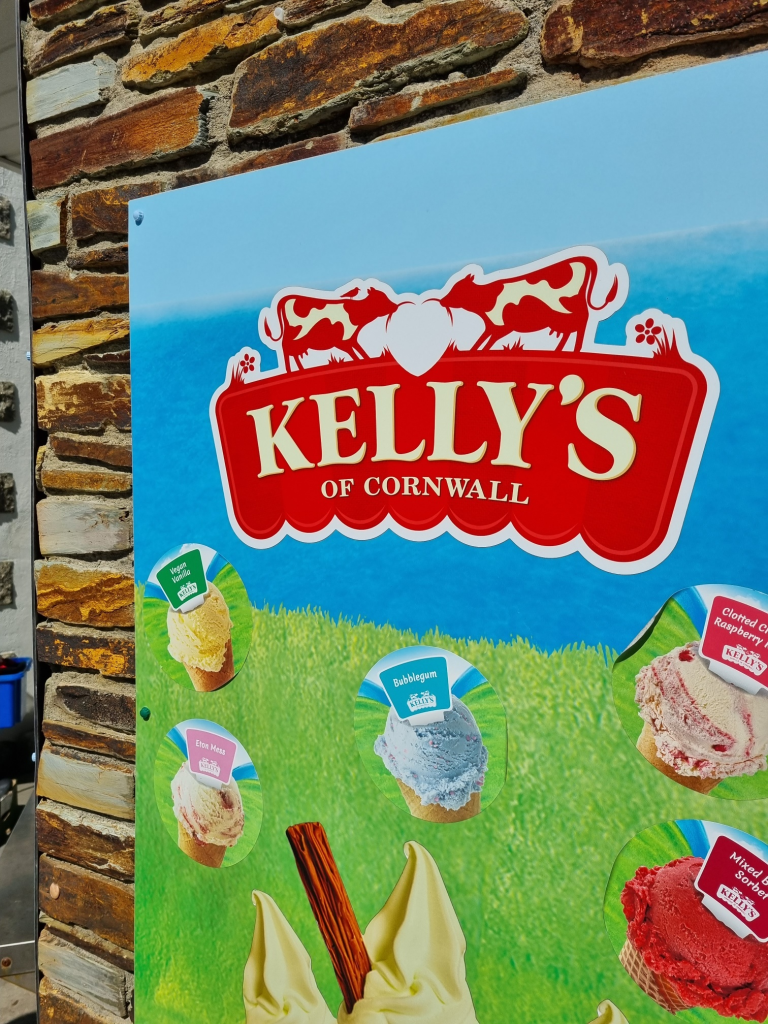
(As an aside, I now have upon my person a traditional recipe for making Cornish clotted cream: and with some of the premium milks now sold by specialty providores in Melbourne with high milkfat and cream content, my children and I will have a crack at making it when next they come for a weekend at my place when I get back to Australia in a few weeks’ time).
The pasties were a two-horse race: one bakery was tastier and cheaper; the other was more generous in the size of its portions. I stuck to the traditional beef, onion and potato variety that is the traditional Cornish pasty: and should you find yourself in Tintagel, pay these people a visit.

My “razzy” award — a golden raspberry to the worst operator in town — has to go to English Heritage, which seems to think charging £20 to walk along the beachfront is an appropriate impost on tourists. (I didn’t pay, for the record). The same organisation was selling an “English Heritage” edition of Monopoly for £50 per set, which is utter highway robbery, notwithstanding novelty/co-branding/souvenir surcharge considerations. For the uninitiated, English Heritage and its rival, the National Trust, between them control access to many of Britain’s best-known and most sought-after attractions, be they buildings, landmarks, or (it seems) dirt and rock too. It was the National Trust that wanted £20 to get into Chartwell had I been able to get there during its truncated opening hours. Readers will note there is no endorsement, or pictorial support, for either of these organisations in this post.
And while the King Arthur’s Arms Inn looked fine, and with a good fish and chippery and several other decent-looking eateries, what started with a pizza last night finished with spicy Tuscan tomato soup and an awesome spaghetti and meatball dinner this evening: simple, rustic Italian fare that was a comforting revelation, and The Olive Garden is worth trying should you ever visit Tintagel.

Simply stated, Tintagel has been a wonderful place to visit.
Tomorrow I’m going north, to North Devon and the township of Barnstaple, before starting my pivot northward in the more general sense later in the week, heading first to Oxfordshire and thence beyond the Midlands to the Lakes District and North Yorkshire.
And, finally, the antibiotic crimp on my activities is now 48 hours away from being dispensed with, which means I can have a drink soon — and this has prevented me from drinking the best beer on the planet, The Proper Job, an IPA Cornish Ale that simply isn’t available in Australia; more’s the pity.
But at least I’ll be able to drink the whisky when I get to Islay in ten days’ time…to do otherwise would be, as a Scottish Australian heading to the old country, an absolute bloody heresy!



 Return To Britain 2022