
I should begin with an apology for last night’s rather half-arsed addition to this online travel journal; I was exhausted, and while in truth I’m no better this evening — it’s been a 240 mile drive today in and around a couple of other things — and so come midnight I will either be asleep or preparing to be so (and this is from someone whose idea of “lights out” is generally 2am).
That photograph you see at the top of the post is how the grave of one of the greatest Englishmen in history, Sir Winston Churchill, appeared when I photographed it this morning; more on that shortly, for before I made the short trek (and it is a trek) from Woodstock to Bladon, I took a couple of photographs of the historic town of Woodstock (in which Blenheim is based) that I would like to share.

Like many of the thousands of picturesque villages dotted across the United Kingdom (and particularly in a place like Oxfordshire, which is one of the prettier boroughs in England), Woodstock was charming: friendly and welcoming people, great places to go and see, and a gorgeous spot of countryside…
…but the accommodations left quite a bit to be desired on the part of an establishment peddling pristine images of a perfectly maintained property on its website, whilst having the unmitigated gall to charge £110 per night for the reality of broken drains, cracked bathroom tiles, ancient stained carpets, the miserly stipend of half a roll of toilet paper, and a near-total lack of ventilation betraying the lie.

I am flirting with posting a “hits and misses” scorecard when I get back to Melbourne to share some travel tips…this place will certainly be omitted from my recommendations (although, ridiculously enough, it served up the best omelette I have EVER had for breakfast this morning. Go figure).
As I tried to explain in my last post, there are plenty of knockers who, when told of a trip like this one, scoff and say, “how boring!” One can only opine that the loss is theirs; these historic old towns are interesting — they don’t have to be famous for much, although some of the ones I’m visiting obviously are — and it’s hard to understate the value of getting out into the countryside, with lots of sweet fresh air (and often fresh salt air, as I’m taking in a lot of coast), doing plenty of long walks and even longer drives. It isn’t like there aren’t people about — I’ve spent just as much time talking and laughing, with old friends and new friends, as I have on my own.
But I digress.
My last act of business in Oxfordshire — having inspected Blenheim Palace yesterday — was to do what I have made a personal tradition whenever I am in Britain: that is, to visit the grave of Sir Winston Churchill, and to pay my respects.
As I said last night, the free world owes Winston a debt; the debt is a continuing one, but a glance at the state of the world today makes one wonder whether his legacy of freedom and liberty is being squandered, but that’s a discussion for another time, and in another place, to be sure.
As I discovered the first time I decided to visit Winston’s grave in 2008, it’s not easy to find despite being in what doesn’t even pass for a one-street town — Bladon, a mile and a half from Woodstock — and it’s not even a case of “blink and you’ll miss it:” it’s tucked away up a side street, and if you don’t know what you’re looking for, you simply won’t find it.
Churchill is buried — in a familial burial yard with many of his ancestors, other relatives, his wife and his children — at St Martin’s Parish Church in Bladon; to approach from the “road” — once you’ve found it — is suggestive of very little. The building itself, while dating only from the 1890s in its current form, looks tired, and an old graveyard as one enters the churchyard screams of dilapidation.
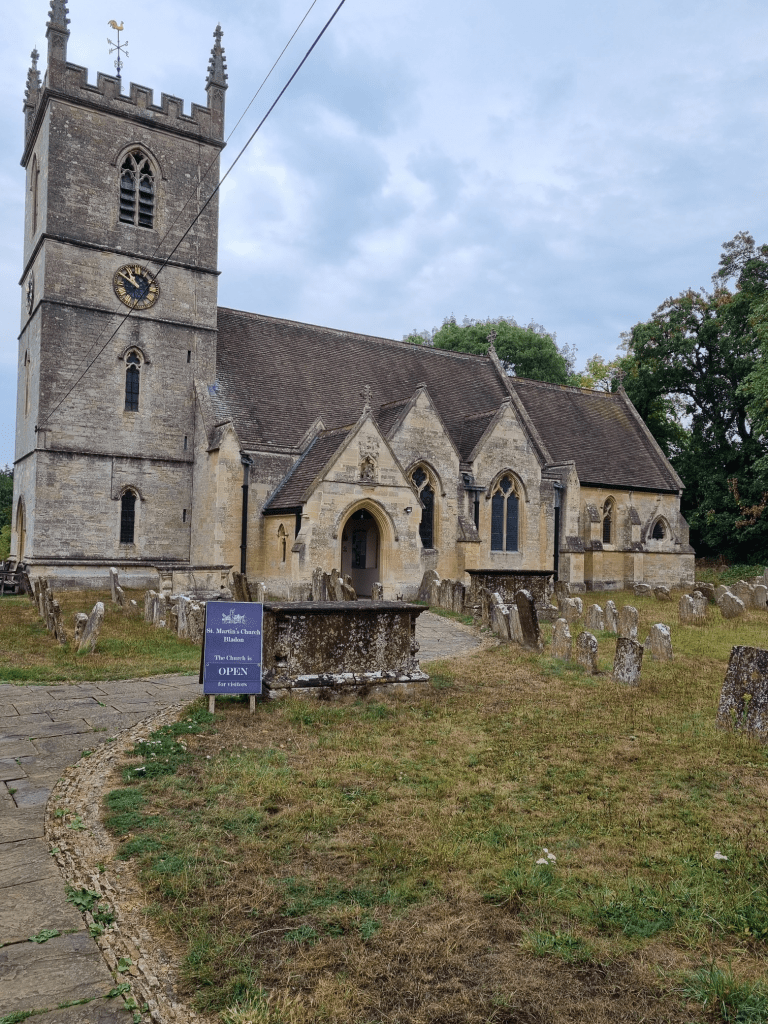
It is believed a church has occupied the site for at least 1,000 years, with partial records dating to the eleventh century predating a mediaeval church that was demolished in 1802, with Churchill’s ancestor George Spencer, 4th Duke of Marlborough, funding the construction of a new church in 1804. This was partly rebuilt in 1891, and remains the current incarnation of the church today.
Behind that church, however, is a second graveyard: no bigger than the rundown cemetery at the front, but immaculately presented, well maintained, and as pretty as a picture. It should come as no surprise that most of the people buried in it are from the Spencer-Churchill clan; the construction of Blenheim Palace and the Marlborough dukedom ensconced the Spencer-Churchills as the pre-eminent aristocratic family in the area, and unlike some of their contemporaries there is plenty to suggest they were benevolent and very generous in their approach to commoners (which should also come as no surprise).
I won’t share the conversation I had with Winston.
But it was a still, heavy morning in Oxfordshire this morning — as it was the first time I went to St Martin’s — and as I entered the Churchill family burial area, a swift and robust gust of wind passed through the graveyard: then subsided completely. The same thing happened in 2008. It was very difficult not to surmise someone was aware of one’s presence. And I have to say, these visits to Sir Winston are surprisingly emotional events.

Once the “formalities” were out of the way, it was into the church to see what had been left out for visitors to buy; when I went to St Martin’s in 2008, I bought two stunning photographic prints — one of Winston in his office, the other of the grave prior to a subsequent restoration — for £10 each, and to the horror of my ex-wife had them professionally framed when we returned to Melbourne (which cost $300: many times more than the value of the photographs). This time I bought some replicas of old war-era postcards bearing slogans (such as “Winnie Will Get Us Through!”) and a CD of British ceremonial music: something that’s suprisingly hard to get really, considering the British have some of the best pomp and ceremony music of any country.

Anything sold goes toward funding the maintenance and upkeep of the building, so I don’t mind spending a tenner or two there when I visit: I will likely leave a small bequest to the St Martin’s Church Trust “when the time comes” — albeit not for several decades yet, if I have anything to do with it — so a little bit now doesn’t hurt.
It was nice to have a few moments of solitude in there too…to reflect, collect my thoughts, and move on with the day.
And speaking of solitude, I had another six-hour dose of it after leaving Bladon late this morning; what should have taken a lot less time — driving from Oxfordshire to the Lakes District — was prolonged by roadworks on the M6 Motorway that created 50 miles of thickly congested traffic that at times barely crawled, dragging the average speed down by about 20mph.
Tonight, I’m staying in Windermere, in Cumbria: a classic Lakes District town, and one very close to William Wordsworth’s infamous daffodils, which I will attempt to get a look at tomorrow before I head up to North Yorkshire — James Herriot country — for the weekend.
If I’m honest, the night in Windemere is a bit of a bonus, and a partly unplanned one; I’ve never been to the Lakes District before this, and it looked impossible to incorporate a stay on this particular trip as I was planning it out. Even so, there was no need to stay longer in Oxfordshire; I couldn’t stay longer in Cornwall before that than I did; and while I have two nights in a gorgeous bed and breakfast in Yorkshire (it’s the ONLY property I’m staying in that was on the itinerary in 2008), it couldn’t be stretched to three nights.
So a night near lakes and daffodils it is: a quick visit, but perhaps better than no visit, and as the Yorkshire town I’m staying in isn’t actually that far away, I can spend most of tomorrow having a good look around before I go.
Hopefully when I post again tomorrow, I may have some lovely daffodils to show, and some snapshots of one of the lakes. It was getting dark by the time I finally made it here this afternoon, so photos — even of the lovely bed and breakfast I’m in for the night — had to wait.
Oh, and the “windy pig?”
I did get to have an excellent dinner at The Pig (apparently known locally as “the windy pig,” for reasons best known to the Cumbrians). A sweet pea and smoked ham soup followed by an awesome piece of pork belly, perfectly crackled and served with creamed potatoes, broccolini, apple sauce and red wine jus, and — of course — a lemon tart. Absolutely splendid!
AND ANOTHER THING: What idiot (and I use this phraseology advisedly) goes to motorway services to gamble? I’m a big fan of Britain’s motorway services system, which offers road travellers a safe stop with passable food options, patrolled toilets, well lit spaces, frequent opportunities to refuel cars and other conveniences, but this?
Each to his own of course, but I think this is just too much.

 Return To Britain 2022