With the very keenest of regret, I’ve left Tintagel and Cornwall behind, as my sweep around and across the United Kingdom gathers pace; the first stop on this onward movement was a spontaneous and partly unexpected treat (and a tip for next time, if I’m honest). But all travel experiences have highs and lows, and it pains me to report that my overnight stop in North Devon is not somewhere I would recommend.

I shot a short video, from my vantage point in front of the Camelot Castle Hotel this morning, but I couldn’t add it to this post (and if anyone knows how to do that, tell me. Please!) I did however also take the photograph above, and with those two pieces of media safely in hand, I hopped into my hire car, and left.
Cornwall has long been a favourite place of mine, but this visit has affected me very deeply, to the point — I’m not ashamed to admit it — I was quite emotional and upset to leave Tintagel today. But I will return: and, God willing, it won’t take another 14 years to get my feet back on British soil, as it did this time.
I’m staying in the North Devon town of Barnstaple this evening (and more on that soon) but the drive across from Tintagel wasn’t long, and I was here soon after noon. Another little job relating to my writing projects — this time to verify some research I did remotely late last year in readiness to start writing my first novel — was in order, and so before I checked into my hotel, I headed to Combe Martin and “the hangmen:” Great Hangman and Little Hangman, the latter being the object of my interest.

There was bad news at first: my assumptions about their accessibility were wrong, and I would need to rewrite a small portion of my draft; there was however a solution in terms of access, which I could incorporate into my story fairly easily, and so aside from the fact I couldn’t personally stand atop Little Hangman today (to do so would require a three-hour return walk up a steep slope) this bad news turned out not to be an issue.
The good news was that as a result of this discovery, other substantial threads of my plot actually become a lot stronger due to the change I have to make: it vindicates the decision to go and see for myself, for of course without credibility and integrity, my storylines would be worthless.
And I was fortunate to learn all of this through an accidental discovery: after roaring through narrow country lanes around Ilfracombe and Combe Martin at 40 and 50 miles per hour — desperately hoping not to meet a car coming the other way — I stumbled on what must count as one of Devon’s hidden gems: The Hunter’s Inn, at the edge of the moor on which the hangmen announce its border with the coast.
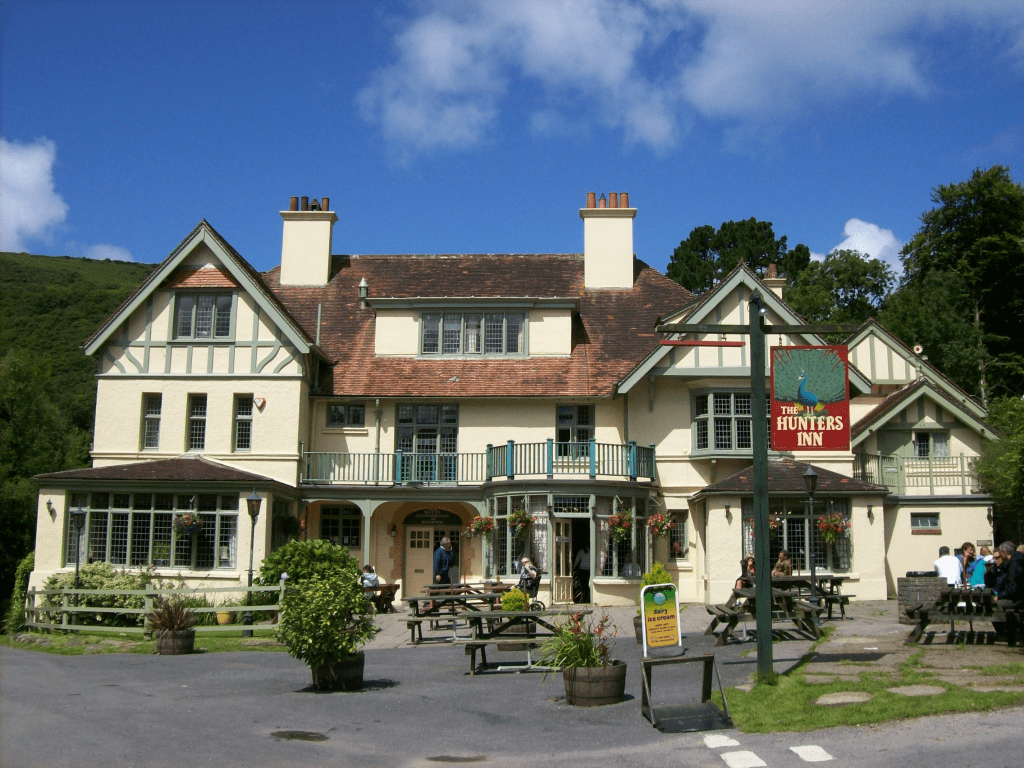
Happily enough, one of the full time managers on duty — a Devon local — had spent a lot of her spare time hiking all over the moors, including the two hangmen, and proved a repository of detailed wisdom about them which I smugly hoovered up. The hangmen are more or less inaccessible by car, she said…and then explained how they could be accessed easily, albeit in a time consuming way, along the “coast path” from Combe Martin. Brilliant.
And as an aside…next time I come to south-west England, The Hunter’s Inn could be a good place to spend a night or two — particularly if an exploration of the moors, and/or the hangmen, is in order. It’s nestled in a super-secluded spot amid acres and acres of lush forest and grassland, in a beautiful old building that I believe has recently been acquired by the National Trust (I know…them again). But the location is excellent and the food menu looked great too, and whilst my preference in Devon is to stay in Dartmouth (which I have periodically flirted with as a place to “retire” — i.e. sit by the water and write books), this might be an acceptable substitute if my preferred spot on the River Dart isn’t an option.
For sadly enough, Barnstaple doesn’t cut the ice.
Every time I think quietly to myself about how much I love Britain, a place like this is thrown into my path: bleak, desolate, with unruly gangs of kids roaming streets which are punctuated by a plethora of empty shops and abandoned livelihoods. Very simply, there’s nothing here, and I say that with enormous reservations and, indeed, sadness. This just isn’t a face of Devon the outside world is meant to see.
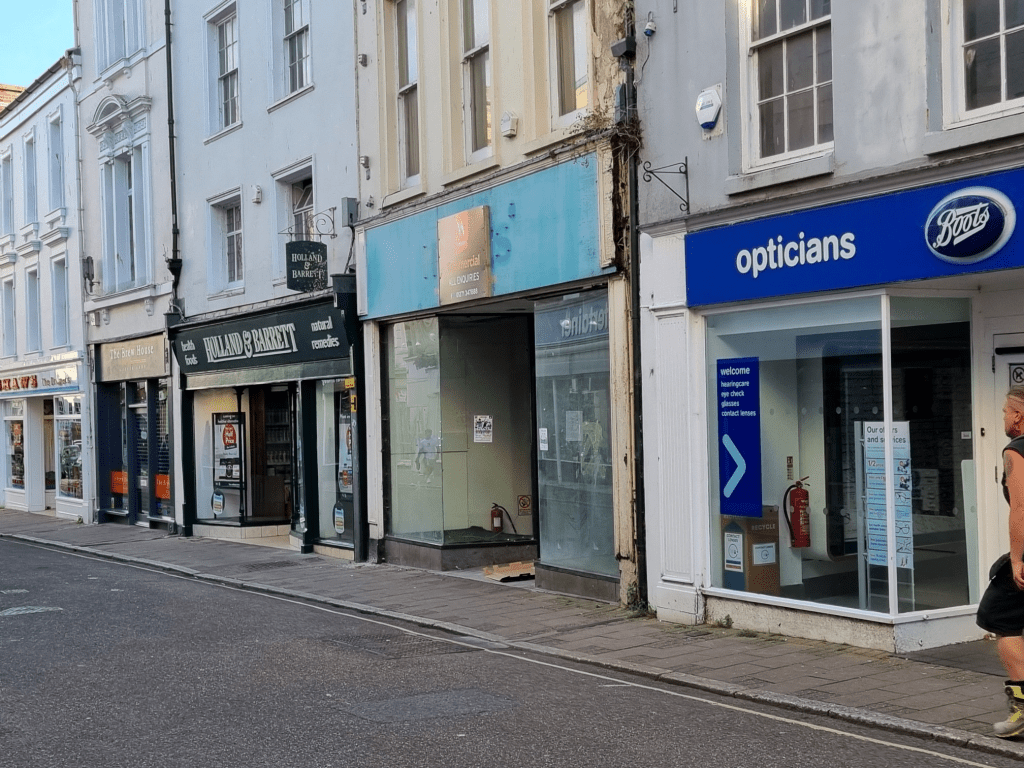
I’m not being horrible. The food options are cheap, mostly trashy, and some of the eateries look like fronts for (ahem) other types of businesses altogether; the town itself isn’t attractive — I’m talking about the built environment, architecture, public amenity — and you get the sense that this is one of those places you don’t come to if you don’t have a functional reason or purpose to be here. Unless you happen to have been born in the nearby North Devon hospital: then you’re likely stuck here for good.
Once again, I’m not being horrible: in fact, I’m only judging the place on what is openly, and abundantly, obvious.
I wish the good people of Barnstaple every good fortune in the world, but I’m off tomorrow, and can only say I’m happy to be on my way.
But that’s travel, isn’t it? 🙂
 Return To Britain 2022